Online first
About the Journal
Current issue
Archive
Publication Ethics
Anti-Plagiarism system
Instructions for Authors
Instructions for Reviewers
Editorial Office
Editorial Board
Contact
Reviewers
All Reviewers
2025
2024
2023
2022
2021
2020
2019
2018
2017
2016
General Data Protection Regulation (RODO)

REVIEW PAPER
Cardiovascular effects of GLP-1 receptor agonists: atherosclerotic outcomes, obesity, HFpEF, and kidney disease — a narrative review.
1
Student Scientific Circle at the Department of Infectious and Tropical Diseases, Andrzej Frycz Modrzewski University, Krakow, Poland
2
Medical College, Andrzej Frycz Modrzewski University, Krakow, Poland
3
Department of Infectious and Tropical Diseases, Andrzej Frycz Modrzewski University, Medical College, Krakow, Poland
Corresponding author
Julia Koźlak
Student Scientific Circle at the Department of Infectious and Tropical Diseases, Andrzej Frycz Modrzewski Krakow University, 30-705 Krakow, Poland
Student Scientific Circle at the Department of Infectious and Tropical Diseases, Andrzej Frycz Modrzewski Krakow University, 30-705 Krakow, Poland
J Pre Clin Clin Res. 2026;20(3):180-186
KEYWORDS
TOPICS
ABSTRACT
Introduction and objective:
Cardiovascular disease (CVD) is a major cause of morbidity and mortality, especially in type 2 diabetes mellitus (T2DM). Selected glucagon-like peptide-1 receptor agonists (GLP-1RAs) provide cardiovascular benefit beyond glucose lowering. The aim of the review is to summarize compound-specific cardiovascular evidence and data in obesity, heart failure with preserved ejection fraction (HFpEF), and chronic kidney disease (CKD).
Review methods:
A narrative review used PubMed, Scopus, and supplementary Google Scholar searches from database inception to 6 August 2026, with reference to SANRA. Landmark cardiovascular outcome trials (CVOTs), randomized trials, meta-analyses, guidelines, and selected mechanistic studies were included. Thirty-two publications were analyzed.
Brief description of the state of knowledge:
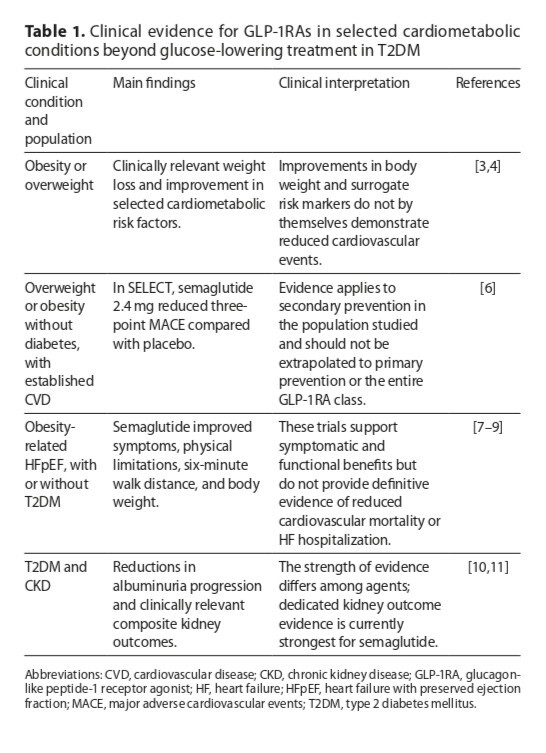
CVOTs show heterogeneous results across GLP-1RAs, ranging from cardiovascular safety to reductions in major adverse cardiovascular events (MACE). SELECT demonstrated secondary-prevention benefit with semaglutide 2.4 mg in adults with overweight or obesity, without diabetes, but with established cardiovascular disease. In obesity-related HFpEF, semaglutide improved symptoms, physical function, and body weight, while effects on mortality and heart-failure hospitalization remain uncertain. Kidney benefits are supported by pooled analyses and FLOW. Gastrointestinal and biliary adverse effects remain relevant safety considerations.
Summary:
GLP-1RAs reduce cardiovascular risk in selected patients with T2DM, but effects are not uniform across the class. Evidence beyond T2DM remains compound- and population-specific, and further studies should clarify long-term safety, hard heart-failure outcomes, comparative effectiveness, and optimal patient selection.
Cardiovascular disease (CVD) is a major cause of morbidity and mortality, especially in type 2 diabetes mellitus (T2DM). Selected glucagon-like peptide-1 receptor agonists (GLP-1RAs) provide cardiovascular benefit beyond glucose lowering. The aim of the review is to summarize compound-specific cardiovascular evidence and data in obesity, heart failure with preserved ejection fraction (HFpEF), and chronic kidney disease (CKD).
Review methods:
A narrative review used PubMed, Scopus, and supplementary Google Scholar searches from database inception to 6 August 2026, with reference to SANRA. Landmark cardiovascular outcome trials (CVOTs), randomized trials, meta-analyses, guidelines, and selected mechanistic studies were included. Thirty-two publications were analyzed.
Brief description of the state of knowledge:
CVOTs show heterogeneous results across GLP-1RAs, ranging from cardiovascular safety to reductions in major adverse cardiovascular events (MACE). SELECT demonstrated secondary-prevention benefit with semaglutide 2.4 mg in adults with overweight or obesity, without diabetes, but with established cardiovascular disease. In obesity-related HFpEF, semaglutide improved symptoms, physical function, and body weight, while effects on mortality and heart-failure hospitalization remain uncertain. Kidney benefits are supported by pooled analyses and FLOW. Gastrointestinal and biliary adverse effects remain relevant safety considerations.
Summary:
GLP-1RAs reduce cardiovascular risk in selected patients with T2DM, but effects are not uniform across the class. Evidence beyond T2DM remains compound- and population-specific, and further studies should clarify long-term safety, hard heart-failure outcomes, comparative effectiveness, and optimal patient selection.
PEER REVIEW INFORMATION
Article has been screened for originality
Gisal M, Koźlak J, Sokół M, Wróblewska K, Leszczyński F, Stopyra L. Cardiovascular effects of GLP-1 receptor agonists: atherosclerotic outcomes, obesity, HFpEF, and kidney disease – a narrative review. J Pre-Clin Clin Res. 2026;20(3):180–186. doi:10.26444/jpccr/235860
REFERENCES (33)
1.
American Diabetes Association Professional Practice Committee for Diabetes. 10. Cardiovascular disease and risk management: Standards of Care in Diabetes—2026. Diabetes Care. 2026;49(Suppl 1):S216–S245. doi:10.2337/dc26-S010.
2.
Marx N, Federici M, Schütt K, et al. 2023 ESC Guidelines for the management of cardiovascular disease in patients with diabetes. Eur Heart J. 2023;44:4043–4140. doi:10.1093/eurheartj/ehad192.
3.
Nauck MA, Quast DR, Wefers J, Meier JJ. GLP-1 receptor agonists in the treatment of type 2 diabetes—state-of-the-art. Mol Metab. 2021;46:101102. doi:10.1016/j.molmet.2020.101102.
4.
Ansari HUH, Qazi SU, Sajid F, et al. Efficacy and safety of glucagon- like peptide-1 receptor agonists on body weight and cardiometabolic parameters in individuals with obesity and without diabetes: a systematic review and meta-analysis. Endocr Pract. 2024;30(2):160–171. doi:10.1016/j.eprac.2023.11.007.
5.
Sattar N, Lee MMY, Kristensen SL, et al. Cardiovascular, mortality, and kidney outcomes with GLP-1 receptor agonists in patients with type 2 diabetes: a systematic review and meta-analysis of randomised trials. Lancet Diabetes Endocrinol. 2021;9:653–662. doi:10.1016/S2213-8587(21)00203-5.
6.
Lincoff AM, Brown-Frandsen K, Colhoun HM, et al. Semaglutide and cardiovascular outcomes in obesity without diabetes. N Engl J Med. 2023;389:2221–2232. doi:10.1056/NEJMoa2307563.
7.
Kosiborod MN, Abildstrøm SZ, Borlaug BA, et al. Semaglutide in patients with heart failure with preserved ejection fraction and obesity. N Engl J Med. 2023;389:1069–1084. doi:10.1056/NEJMoa2306963.
8.
Kosiborod MN, Petrie MC, Borlaug BA, et al. Semaglutide in patients with obesity-related heart failure and type 2 diabetes. N Engl J Med. 2024;390:1394–1407. doi:10.1056/NEJMoa2313917.
9.
Butler J, Shah SJ, Petrie MC, et al. Semaglutide versus placebo in people with obesity-related heart failure with preserved ejection fraction: a pooled analysis of the STEP-HFpEF and STEP-HFpEF DM randomised trials. Lancet. 2024;403:1635–1648. doi:10.1016/S0140-6736(24)00469-0.
10.
Badve SV, Bilal A, Lee MMY, et al. Effects of GLP-1 receptor agonists on kidney and cardiovascular disease outcomes: a meta-analysis of randomised controlled trials. Lancet Diabetes Endocrinol. 2025;13:15–28. doi:10.1016/S2213-8587(24)00271-7.
11.
Perkovic V, Tuttle KR, Rossing P, et al. Effects of semaglutide on chronic kidney disease in patients with type 2 diabetes. N Engl J Med. 2024;391:109–121. doi:10.1056/NEJMoa2403347.
12.
Baethge C, Goldbeck-Wood S, Mertens S. SANRA—a scale for the quality assessment of narrative review articles. Res Integr Peer Rev. 2019;4:5. doi:10.1186/s41073-019-0064-8.
13.
Marx N, Husain M, Lehrke M, Verma S, Sattar N. GLP-1 receptor agonists for the reduction of atherosclerotic cardiovascular risk in patients with type 2 diabetes. Circulation. 2022;146:1882–1894. doi:10.1161/CIRCULATIONAHA.122.059595.
14.
Park B, Bakbak E, Teoh H, et al. GLP-1 receptor agonists and atherosclerosis protection: the vascular endothelium takes center stage. Am J Physiol Heart Circ Physiol. 2024;326(5):H1159–H1176. doi:10.1152/ajpheart.00574.2023.
15.
Helmstädter J, Frenis K, Filippou K, et al. Endothelial GLP-1 receptor mediates cardiovascular protection by liraglutide in mice with experimental arterial hypertension. Arterioscler Thromb Vasc Biol. 2020;40:145–158. doi:10.1161ATV.0000615456.97862.30.
16.
Baggio LL, Drucker DJ. Glucagon-like peptide-1 receptor co-agonists for treating metabolic disease. Mol Metab. 2021;46:101090. doi:10.1016/j.molmet.2020.101090.
17.
Drucker DJ. Mechanisms of action and therapeutic application of glucagon-like peptide-1. Cell Metab. 2018;27:740–756. doi:10.1016/j.cmet.2018.03.001.
18.
Battistoni A, Piras L, Tartaglia N, et al. Glucagon-like peptide-1 receptor agonists and the endothelium: molecular and clinical insights into cardiovascular protection. Front Med. 2025;12:1669685. doi:10.3389/fmed.2025.1669685.
19.
Chen JY, Hsu TW, Liu JH, et al. Kidney and cardiovascular outcomes among patients with CKD receiving GLP-1 receptor agonists: a systematic review and meta-analysis of randomized trials. Am J Kidney Dis. 2025;85:555–569.e1. doi:10.1053/j.ajkd.2024.11.013.
20.
Sattar N, McGuire DK. Pathways to cardiorenal complications in type 2 diabetes mellitus: a need to rethink. Circulation. 2018;138:7–9. doi:10.1161/CIRCULATIONAHA.118.035083.
21.
Pfeffer MA, Claggett B, Diaz R, et al. Lixisenatide in patients with type 2 diabetes and acute coronary syndrome. N Engl J Med. 2015;373:2247–2257. doi:10.1056/NEJMoa1509225.
22.
Marso SP, Daniels GH, Brown-Frandsen K, et al. Liraglutide and cardiovascular outcomes in type 2 diabetes. N Engl J Med. 2016;375:311–322. doi:10.1056/NEJMoa1603827.
23.
Marso SP, Bain SC, Consoli A, et al. Semaglutide and cardiovascular outcomes in patients with type 2 diabetes. N Engl J Med. 2016;375:1834–1844. doi:10.1056/NEJMoa1607141.
24.
Holman RR, Bethel MA, Mentz RJ, et al. Effects of once-weekly exenatide on cardiovascular outcomes in type 2 diabetes. N Engl J.Med. 2017;377:1228–1239. doi:10.1056/NEJMoa1612917.
25.
Hernandez AF, Green JB, Janmohamed S, et al. Albiglutide and cardiovascular outcomes in patients with type 2 diabetes and cardiovascular disease (Harmony Outcomes): a double-blind, randomised placebo-controlled trial. Lancet. 2018;392:1519–1529.doi:10.1016/S0140-6736(18)32261-X.
26.
Gerstein HC, Colhoun HM, Dagenais GR, et al. Dulaglutide and cardiovascular outcomes in type 2 diabetes (REWIND): a double-blind, randomised placebo-controlled trial. Lancet. 2019;394:121–130. doi:10.1016/S0140-6736(19)31149-3.
27.
Husain M, Birkenfeld AL, Donsmark M, et al. Oral semaglutide and cardiovascular outcomes in patients with type 2 diabetes. N Engl J Med.2019;381:841–851. doi:10.1056/NEJMoa1901118.
28.
Gerstein HC, Sattar N, Rosenstock J, et al. Cardiovascular and renal outcomes with efpeglenatide in type 2 diabetes. N Engl J Med. 2021;385:896–907. doi:10.1056/NEJMoa2108269.
29.
McGuire DK, Marx N, Mulvagh SL, et al. Oral semaglutide and cardiovascular outcomes in high-risk type 2 diabetes. N Engl J Med. 2025;392:2001–2012. doi:10.1056/NEJMoa2501006.
30.
Giugliano D, Maiorino MI, Bellastella G, et al. GLP-1 receptor agonists for prevention of cardiorenal outcomes in type 2 diabetes: an updated meta-analysis including the REWIND and PIONEER 6 trials. Diabetes Obes Metab. 2019;21:2576–2580.doi:10.1111dom.13847.
31.
Kalayci A, Januzzi JL Jr, Mitsunami M, et al. Clinical features modifying the cardiovascular benefits of GLP-1 receptor agonists: a systematic review and meta-analysis. Eur Heart J Cardiovasc Pharmacother. 2025;11:552–561. doi:10.1093/ehjcvp/pvaf037.
32.
Zelniker TA, Wiviott SD, Raz I, et al. Comparison of the effects of glucagonlike peptide receptor agonists and sodium-glucose cotransporter 2 inhibitors for prevention of major adverse cardiovascular and renal outcomes in type 2 diabetes mellitus. Circulation. 2019;139:2022–2031. doi:10.1161/CIRCULATIONAHA.118.038868.
33.
Galli M, Benenati S, Laudani C, et al. Cardiovascular effects and tolerability of GLP-1 receptor agonists: a systematic review and metaanalysis of 99,599 patients. J Am Coll Cardiol. 2025;86(20):1805–1819. doi:10.1016/j.jacc.2025.08.027.
Share
RELATED ARTICLE
| eISSN: | 1898-7516 |
| ISSN: | 1898-2395 |

We process personal data collected when visiting the website. The function of obtaining information about users and their behavior is carried out by voluntarily entered information in forms and saving cookies in end devices. Data, including cookies, are used to provide services, improve the user experience and to analyze the traffic in accordance with the Privacy policy. Data are also collected and processed by Google Analytics tool (more).
You can change cookies settings in your browser. Restricted use of cookies in the browser configuration may affect some functionalities of the website.
You can change cookies settings in your browser. Restricted use of cookies in the browser configuration may affect some functionalities of the website.