Online first
About the Journal
Current issue
Archive
Publication Ethics
Anti-Plagiarism system
Instructions for Authors
Instructions for Reviewers
Editorial Office
Editorial Board
Contact
Reviewers
All Reviewers
2025
2024
2023
2022
2021
2020
2019
2018
2017
2016
General Data Protection Regulation (RODO)
REVIEW PAPER
Cardiovascular, respiratory, and metabolic adaptations in amateur Ironman training – a narrative review
1
Medical Faculty, University of Opole, Poland
2
Medical Faculty, Medical University, Wroclaw, Poland
These authors had equal contribution to this work
J Pre Clin Clin Res. 2026;20(3):174-179
KEYWORDS
TOPICS
ABSTRACT
Introduction and objective:
Ironman triathlon is an ultra-endurance discipline requiring prolonged high-intensity exercise and substantial physiological adaptation. The aim of this narrative review is to summarise current evidence regarding cardiovascular, respiratory, and metabolic adaptations associated with long-term Ironman training in amateur athletes.
Review methods:
A narrative review of the literature published between 2015–2026 was conducted using PubMed and Scopus databases. Studies concerning cardiovascular, respiratory, metabolic, and body composition adaptations associated with prolonged endurance exercise were included.
Brief description of the state of knowledge:
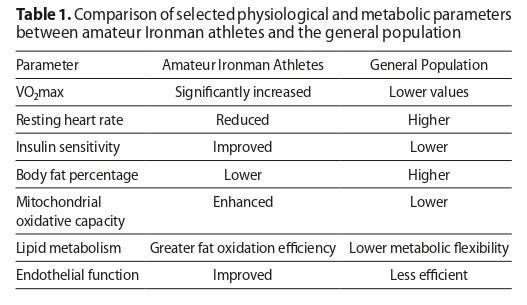
Ironman training induces significant systemic adaptations, including increased VO2max, enhanced ventilatory efficiency, improved respiratory muscle endurance, favourable metabolic adaptations, and physiological cardiac remodelling referred to as ‘athlete’s heart’. However, chronic excessive endurance exercise may also contribute to adverse outcomes, including myocardial fibrosis, arrhythmias, airway dysfunction, and prolonged physiological stress in susceptible individuals.
Summary:
Long-term Ironman training is associated with substantial cardiovascular, respiratory, and metabolic benefits. Nevertheless, excessive training volume and intensity may contribute to adverse physiological consequences. Appropriate balancing of training load and recovery appears essential for optimising performance while minimising long-term health risk.
Ironman triathlon is an ultra-endurance discipline requiring prolonged high-intensity exercise and substantial physiological adaptation. The aim of this narrative review is to summarise current evidence regarding cardiovascular, respiratory, and metabolic adaptations associated with long-term Ironman training in amateur athletes.
Review methods:
A narrative review of the literature published between 2015–2026 was conducted using PubMed and Scopus databases. Studies concerning cardiovascular, respiratory, metabolic, and body composition adaptations associated with prolonged endurance exercise were included.
Brief description of the state of knowledge:
Ironman training induces significant systemic adaptations, including increased VO2max, enhanced ventilatory efficiency, improved respiratory muscle endurance, favourable metabolic adaptations, and physiological cardiac remodelling referred to as ‘athlete’s heart’. However, chronic excessive endurance exercise may also contribute to adverse outcomes, including myocardial fibrosis, arrhythmias, airway dysfunction, and prolonged physiological stress in susceptible individuals.
Summary:
Long-term Ironman training is associated with substantial cardiovascular, respiratory, and metabolic benefits. Nevertheless, excessive training volume and intensity may contribute to adverse physiological consequences. Appropriate balancing of training load and recovery appears essential for optimising performance while minimising long-term health risk.
PEER REVIEW INFORMATION
Article has been screened for originality
Hariasz W, Gontkowska A, Zalewska A, Drobik M, Gądek K, Borowiec M, Reczek K, Lichodij A. Cardiovascular, respiratory, and metabolic adaptations in amateur Ironman training – a narrative review. J Pre-Clin Clin Res. 2026;20(3):174–179. doi:10.26444/jpccr/226017
REFERENCES (56)
1.
Bridel W. From bar bet to fitness craze for weekend warriors: a genealogical analysis of the Ironman® triathlon. Leisure. 2015;39(1):81–105. doi:10.1080/14927713.2015.1074399.
2.
Kostyra A. The triathletes feeling before sports competitions. J Educ Health Sport. 2021;6(9):922–941. doi:10.5281 zenodo.167596.
3.
Rajesh S, Kumar R, Akhila G, et al. Training for long distance athletes 1st ed. Hyderabad, 2025.
5.
Fister I, Brest J, Iglesias A, et al. Framework for planning the training sessions in triathlon. In: Proceedings of the Genetic and Evolutionary Computation Conference Companion. GECCO ’18. Association for Computing Machinery; 2018:1829–1834. doi:10.1145/3205651.3208242.
6.
Etxebarria N, Mujika I, Pyne D. Training and Competition Readiness in Triathlon. Sports. 2019;7(5):101. doi:10.3390/sports7050101.
7.
Małek O, Witkoś J, Wróbel P, et al. Triathlon – the impact of trainings on athlete’s musculoskeletal system. Emergency Duty. 2016;9:16–23.
8.
Sinisgalli R, de Lira CAB, Vancini RL, et al. Impact of training volume and experience on amateur Ironman triathlon performance. Physiol Behav. 2021;232:113344. doi:10.1016/j.physbeh.2021.113344.
9.
Esteve-Lanao J, Moreno-Pérez D, Cardona CA, et al. Is Marathon Training Harder than the Ironman Training? An ECO-method Comparison. Front Physiol. 2017;8:298. doi:10.3389/fphys.2017.00298.
10.
Ash H, Penker M. Ironman 70.3: Training for the Middle Distance. 2nd ed. Maidenhead, 2011.
11.
Muñoz I, Cejuela R, Seiler S, et al. Training-Intensity Distribution During an Ironman Season: Relationship With Competition Performance. Int J Sports Physiol Perform. 2014;9(2):332–339. doi:10.1123/ijspp.2012-0352.
12.
Selles-Perez S, Fernández-Sáez J, Cejuela R. Polarized and Pyramidal Training Intensity Distribution: Relationship with a Half-Ironman Distance Triathlon Competition. J Sports Sci Med. 2019;18(4):708–715.
13.
Sharma S, Merghani A, Mont L. Exercise and the heart: the good, the bad, and the ugly. Eur Heart J. 2015;36(23):1445–1453. doi:10.1093/eurheartj/ehv090.
14.
Malińska M, Młynarczyk M. Dynamic physical effort – selected issues. Hygeia Public Health. 2020;55(1):7–13.
15.
Scheer V, Tiller NB, Doutreleau S, et al. Potential Long-Term Health Problems Associated with Ultra-Endurance Running: A Narrative Review. Sports Med. 2022;52(4):725–740. doi:10.1007/s40279-021-01561-3.
16.
Borrego-Sánchez A, Vinolo-Gil MJ, de-la-Casa-Almeida M, et al. Effects of Training on Cardiorespiratory Fitness in Triathletes: A Systematic Review and Meta-Analysis. Int J Environ Res Public Health. 2021;18(24):13332. doi:10.3390/ijerph182413332.
17.
Ranković G, Mutavdžić V, Toskić D, et al. Aerobic capacity as an indicator in different kinds of sports. Bosn J Basic Med Sci. 2010;10(1):44–48. doi:10.17305/bjbms.2010.2734.
18.
Lee J, Zhang XL. Physiological determinants of VO2max and the methods to evaluate it: A critical review. Sci Sports. 2021;36(4):259–271. doi:10.1016/j.scispo.2020.11.006.
19.
LeWine HE. VO2 max: What it is and how you can improve it. https://www.health.harvard.edu... (access: 2026.05.16).
20.
Balsam P, Szmit S, Opolski G. Trening a wydolność fizyczna organizmu – VO2maks oraz VO2AT. Kardiol Dypl. 2009;8(8):49–54.
21.
Granero-Gallegos A, González-Quílez A, Plews D, et al. HRV- Based Training for Improving VO2max in Endurance Athletes. A. Systematic Review with Meta-Analysis. Int J Environ Res Public Health. 2020;17(21):7999. doi:10.3390/ijerph17217999.
22.
Syamsudin F, Syaifullah R, Subardi MB, et al. Interval Training and Endurance Training to Increase VO2max: Article Review. Juara. 2021;6(2):188–197. doi:10.33222/juara.v6i2.1227.
24.
Hackett DA. Lung Function and Respiratory Muscle Adaptations of Endurance- and Strength-Trained Males. Sports. 2020;8(12):160. doi:10.3390/sports8120160.
25.
Dempsey JA, La Gerche A, Hull JH. Is the healthy respiratory system built just right, overbuilt, or underbuilt to meet the demands imposed by exercise? J Appl Physiol. 2020;129(6):1235–1256. doi:10.1152/japplphysiol.00444.2020.
26.
Deliceoğlu G, Kabak B, Çakır VO, et al. Respiratory Muscle Strength as a Predictor of VO2max and Aerobic Endurance in Competitive Athletes. Appl Sci. 2024;14(19):8976. doi:10.3390/app14198976.
27.
Morici G, Gruttad’Auria CI, Baiamonte P, et al. Endurance training: is it bad for you? Breathe. 2016;12(2):140–147. doi:10.1183/20734735.007016.
28.
Shavit R, Glikson M, Constantini N. Athlete’s heart – the more the merrier? Harefuah. 2016;155(9):531–536.
29.
Galanti G, Stefani L, Mascherini G, et al. Left ventricular remodeling and the athlete’s heart, irrespective of quality load training. Cardiovasc Ultrasound. 2016;14(1):46. doi:10.1186/s12947-016-0088-x.
30.
Baggish AL, Wood MJ. Athlete’s Heart and Cardiovascular Care of the Athlete. Circ. 2011;123(23):2723–2735. doi:10.1161/CIRCULATIONAHA.110.981571.
31.
Khan AA, Safi L, Wood M. Cardiac Imaging In Athletes. Methodist Debakey Cardiovasc J. 2016;12(2):86–92. doi:10.14797/mdcj-12-2-86.
32.
Stadiotti I, Lippi M, Maione AS, et al. Cardiac Biomarkers and Autoantibodies in Endurance Athletes: Potential Similarities with Arrhythmogenic Cardiomyopathy Pathogenic Mechanisms. Int J Mol Sci. 2021;22(12):6500. doi:10.3390/ijms22126500.
33.
Kusy K, Błażejewski J, Gilewski W, et al. Aging Athlete’s Heart: An Echocardiographic Evaluation of Competitive Sprint- versus Endurance-Trained Master Athletes. J Am Soc Echocardiogr. 2021;34(11):1160–1169. doi:10.1016/j.echo.2021.06.009.
34.
McDiarmid AK, Swoboda PP, Erhayiem B, et al. Athletic Cardiac Adaptation in Males Is a Consequence of Elevated Myocyte Mass. Circ Cardiovasc Imaging. 2016;9(4):e003579. doi:10.1161/CIRCIMAGING.115.003579.
35.
Tran M, Kwon A, Holt D, et al. Echocardiographic Pulmonary to Left Atrial Ratio (ePLAR): A Comparison Study between Ironman Athletes, Age Matched Controls and A General Community Cohort. J Clin Med. 2019;8(10):1756. doi:10.3390/jcm8101756.
36.
D’Ascenzi F, Anselmi F, Focardi M, et al. Atrial Enlargement in the Athlete’s Heart: Assessment of Atrial Function May Help Distinguish Adaptive from Pathologic Remodeling. J Am Soc Echocardiogr. 2018;31(2):148–157. doi:10.1016/j.echo.2017.11.009.
37.
Finocchiaro G, Sharma S. Do Endurance Sports Affect Female Hearts Differently to Male hearts? Future Cardiol. 2016;12(2):105–108. doi:10.2217/fca.15.85.
38.
Kovacs R, Baggish AL. Cardiovascular adaptation in athletes. Trends in Cardiovasc Med. 2016;26(1):46–52. doi:10.1016/j.tcm.2015.04.003.
39.
Kwon O, Park S, Kim YJ, et al. The exercise heart rate profile in master athletes compared to healthy controls. Clin Physiol Funct Imagining. 2016;36(4):286–292. doi:10.1111/cpf.12226.
40.
Dawkins TG, Shave RE, Baggish AL, et al. Electrocardiographic changes following six months of long-distance triathlon training in previously recreationally active individuals. Eur J Sport Sci. 2020;20(4):553–562. doi:10.1080/17461391.2019.1641556.
41.
La Gerche A, Claessen G, Dymarkowski S, et al. Exercise-induced right ventricular dysfunction is associated with ventricular arrhythmias in endurance athletes. Eur Heart J. 2015;36(30):1998–2010. doi:10.1093/ eurheartj/ehv202.
42.
Gąsior P. Aerobic physical activity and the potential risk of developing certain diseases. Polish J Sport Med. 2024;40:167–175. doi:10.5604/01.3001.0054.8717.
43.
Guarnieri G, Pozzi FE, Conte E, et al. Extreme endurance training and coronary artery disease: A systematic review and a meta-analysis. Int J Cardiol. 2025;429:133172. doi:10.1016/j.ijcard.2025.133172.
44.
Dupont AC, Poussel M, Hossu G, et al. Aortic compliance variation in long male distance triathletes: A new insight into the athlete’s artery? J Sci Med Sport. 2017;20(6):539–542. doi:10.1016/j.jsams.2016.10.009.
45.
Lin J, DeLuca JR, Lu MT, et al. Extreme Endurance Exercise and Progressive Coronary Artery Disease. J Am Coll Cardiol. 2017;70(2):293–295. doi:10.1016/j.jacc.2017.05.016.
46.
Frandsen J, Vest S, Larsen S, et al. Maximal Fat Oxidation is Related to Performance in an Ironman Triathlon. Int J Sports Med. 2017;38(13):975–982. doi:10.1055/s-0043-117178.
47.
Klepochová R, Valkovič L, Hochwartner T, et al. Differences in Muscle Metabolism Between Triathletes and Normally Active Volunteers Investigated Using Multinuclear Magnetic Resonance Spectroscopy at 7T. Front Physiol. 2018;9. doi:10.3389/fphys.2018.00300.
48.
Teległów A, Borowiec R, Marchewka J, et al. Impact of vigorous effort on blood morphological indicators in triathletes participating in the XTERRA Poland 2017 competition. Med Rehabil. 2020;24:20–26.doi:10.5604/01.3001.0014.5097.
49.
Teległów A, Marchewka J, Tota Ł, et al. Changes in the Morphological, Rheological, and Biochemical Blood Indicators in Triathletes. Folia Biol. 2020;68(3):107–120. doi:10.3409/fb_68-3.13.
50.
Baur DA, Bach CW, Hyder WJ, et al. Fluid retention, muscle damage, and altered body composition at the Ultraman triathlon. Eur J Appl Physiol. 2016;116(3):447–458. doi:10.1007/s00421-015-3291-9.
51.
Bolotin A, Bakayev V. The differences in response of the respiratory system of long and middle-distance runners and their influence on recovery rate. JPES. 2017;17(04):2443–2446.
52.
Sellés-Pérez S, Fernández-Sáez J, Férriz-Valero A, et al. Changes in Triathletes’ Performance and Body Composition During a Specific Training Period for a Half-Ironman Race. J Hum Kinet. 2019;67:185–198. doi:10.2478/hukin-2018-0077.
53.
Kandel M, Baeyens JP, Clarys P. Somatotype, training and performance in Ironman athletes. Eur J Sport Sci. 2014;14(4):301–308. doi:10.1080/17461391.2013.813971.
54.
Clemente-Suárez VJ, Delgado-Moreno R, González B, et al. Amateur endurance triathletes’ performance is improved independently of volume or intensity based training. Physiol Behav. 2019;205:2–8. doi:10.1016/j.physbeh.2018.04.014.
55.
Navarro V, Granell J, Malavés R. Influence of fat mass for the VO2max and ventilatory thresholds in young athletes of endurance sport specialties Influencia de la masa grasa para el VO2max y Umbrales Ventilatorios en jóvenes deportistas de especialidades deportivas de resistencia. Sportis Sci J. 2017;3:16–33.
56.
Żarski TP, Gorący A. Physical activity in the prevention of cardiovascular diseases (CVD). Physical Activity and Health. 2017;12:1–9.
| eISSN: | 1898-7516 |
| ISSN: | 1898-2395 |

We process personal data collected when visiting the website. The function of obtaining information about users and their behavior is carried out by voluntarily entered information in forms and saving cookies in end devices. Data, including cookies, are used to provide services, improve the user experience and to analyze the traffic in accordance with the Privacy policy. Data are also collected and processed by Google Analytics tool (more).
You can change cookies settings in your browser. Restricted use of cookies in the browser configuration may affect some functionalities of the website.
You can change cookies settings in your browser. Restricted use of cookies in the browser configuration may affect some functionalities of the website.