Online first
About the Journal
Current issue
Archive
Publication Ethics
Anti-Plagiarism system
Instructions for Authors
Instructions for Reviewers
Editorial Office
Editorial Board
Contact
Reviewers
All Reviewers
2025
2024
2023
2022
2021
2020
2019
2018
2017
2016
General Data Protection Regulation (RODO)
REVIEW PAPER
Transcranial direct current stimulation for the treatment of Obsessive-Compulsive Disorder – a narrative literature review
1
Student Scientific Association at the Clinical Oncology and Chemotherapy Clinic, University Clinical Hospital No. 4, Medical University, Lublin, Poland
2
Student Scientific Association, Department of Pneumonology, Oncology and Allergology, Medical University, Lublin, Poland
3
Department of Clinical Oncology and Chemotherapy, Medical University, Lublin, Poland
Corresponding author
Filip Kazimierz Gajewski
Student Scientific Association at the Department of Pneumonology, Oncology and Allergology, Medical University, Lublin, Poland
Student Scientific Association at the Department of Pneumonology, Oncology and Allergology, Medical University, Lublin, Poland
J Pre Clin Clin Res. 2026;20(2):75-81
KEYWORDS
obsessive-compulsive disordertranscranial direct current stimulationneuromodulationefficacybrain stimulation therapy
TOPICS
ABSTRACT
Introduction and objective:
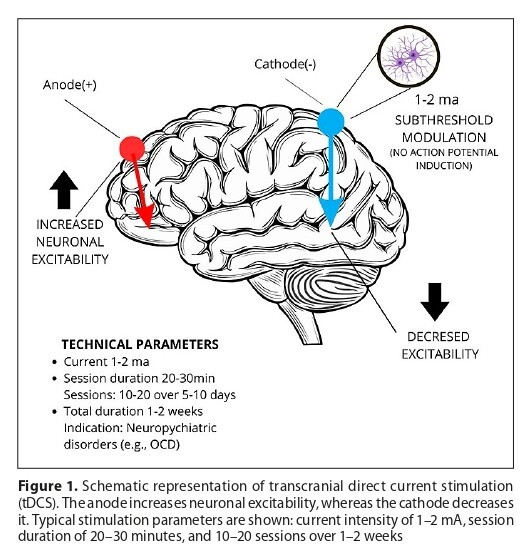
Obsessive-compulsive disorder (OCD) is a chronic, often treatment-resistant condition involving dysfunction in the cortico-striato-thalamo-cortical (CSTC) circuit and neurotransmitter imbalances. Standard treatments, including SSRIs and cognitive-behavioral therapy (CBT), are insufficient for a substantial proportion of patients. Transcranial direct current stimulation (tDCS), a non-invasive, cost-effective neuromodulation technique, has emerged as a potential therapeutic option. The aim of the review is to critically evaluate current evidence on the efficacy, safety, and clinical utility of tDCS in OCD treatment, emphasizing optimal stimulation targets, parameters, therapeutic outcomes, and areas requiring further investigation
Review methods:
A literature review was conducted using PubMed and Google Scholar databases (2020–2025), based on key words: ‘transcranial direct current stimulation’, ‘obsessive-compulsive disorder’, ‘brain stimulation’, ‘efficacy’, and ‘neuromodulation’.
Brief description of the state of knowledge:
Evidence suggests that stimulation of the pre-SMA, dlPFC, OFC, and ACC can significantly reduce OCD symptom severity. Meta-analyses report moderate short-term efficacy with a favourable safety profile. However, patient responses vary widely, and current studies use heterogeneous protocols with inconsistent outcome measures.
Summary:
tDCS demonstrates promising short-term benefits and good tolerability in treating OCD, particularly when targeting cortico-striatal network hubs. However, lack of standardized protocols and limited long-term data constrain its clinical adoption. High-quality randomized trials with uniform methodologies are essential to validate its role as a reliable adjunctive treatment in OCD management.
Obsessive-compulsive disorder (OCD) is a chronic, often treatment-resistant condition involving dysfunction in the cortico-striato-thalamo-cortical (CSTC) circuit and neurotransmitter imbalances. Standard treatments, including SSRIs and cognitive-behavioral therapy (CBT), are insufficient for a substantial proportion of patients. Transcranial direct current stimulation (tDCS), a non-invasive, cost-effective neuromodulation technique, has emerged as a potential therapeutic option. The aim of the review is to critically evaluate current evidence on the efficacy, safety, and clinical utility of tDCS in OCD treatment, emphasizing optimal stimulation targets, parameters, therapeutic outcomes, and areas requiring further investigation
Review methods:
A literature review was conducted using PubMed and Google Scholar databases (2020–2025), based on key words: ‘transcranial direct current stimulation’, ‘obsessive-compulsive disorder’, ‘brain stimulation’, ‘efficacy’, and ‘neuromodulation’.
Brief description of the state of knowledge:
Evidence suggests that stimulation of the pre-SMA, dlPFC, OFC, and ACC can significantly reduce OCD symptom severity. Meta-analyses report moderate short-term efficacy with a favourable safety profile. However, patient responses vary widely, and current studies use heterogeneous protocols with inconsistent outcome measures.
Summary:
tDCS demonstrates promising short-term benefits and good tolerability in treating OCD, particularly when targeting cortico-striatal network hubs. However, lack of standardized protocols and limited long-term data constrain its clinical adoption. High-quality randomized trials with uniform methodologies are essential to validate its role as a reliable adjunctive treatment in OCD management.
Burdan O, Kurec G, Gajewski FK, Szklener K. Transcranial direct current stimulation for the treatment of Obsessive-Compulsive Disorder –
a narrative literature review. J Pre-Clin Clin Res. 2026;20(2):75–81. doi:10.26444/jpccr/221226
REFERENCES (31)
1.
Moshfeghinia R, Najibi A, Golabi F, Moradi M, Malekpour M, Abdollahifard S, Slavin K, Razmkon A. Efficacy and safety of transcranial direct current stimulation (tDCS) in patients with obsessive-compulsive disorder (OCD): A systematic review and metaanalysis of randomized controlled trials. Neurosci Biobehav Rev. 2025 Jun;173:106171. doi:10.1016/j.neubiorev.2025.106171.
2.
Pellegrini L, Cinosi E, Wellsted D, Smith M, Busby A, Hall N, Albert U, Aslan I, Garner M, Chamberlain SR, Robbins TW, Baldwin DS, Fineberg NA. Effects of transcranial direct current stimulation (tDCS) at different cortical targets on cognition in obsessive-compulsive disorder (OCD): an exploratory analysis. Int Clin Psychopharmacol. 2025 Apr 4. doi:10.1097/YIC.0000000000000589.
3.
Soleimani G, Nitsche MA, Hanlon CA, Lim KO, Opitz A, Ekhtiari H. Four dimensions of individualization in brain stimulation for psychiatric disorders: context, target, dose, and timing. Neuropsychopharmacology. 2025 May;50(6):857–870. doi:10.1038/s41386-025-02094-3.
4.
Hyde J, Carr H, Kelley N, Seneviratne R, Reed C, Parlatini V, Garner M, Solmi M, Rosson S, Cortese S, Brandt V. Efficacy of neurostimulation across mental disorders: systematic review and meta-analysis of 208 randomized controlled trials. Mol Psychiatry. 2022 Jun;27(6):2709–2719. doi:10.1038/s41380-022-01524-8. Epub 2022 Apr 1. PMID: 35365806; PMCID: PMC8973679.
5.
Fregni F, El-Hagrassy MM, Pacheco-Barrios K, Carvalho S, Leite J, Simis M, Brunelin J, Nakamura-Palacios EM, Marangolo P, Venkatasubramanian G, San-Juan D, Caumo W, Bikson M, Brunoni AR. Neuromodulation Center Working Group. Evidence-Based Guidelines and Secondary Meta-Analysis for the Use of Transcranial Direct Current Stimulation in Neurological and Psychiatric Disorders. Int J Neuropsychopharmacol. 2021 Apr 21;24(4):256–313. doi:10.1093/ijnp/pyaa051.
6.
Shi W, Tian Y, Yang H, Guo H, Wen B, Liu Z, Zhang Y, Han S, Cheng J. Abnormal static and dynamic functional connectivity of striatal subregions in patients with obsessive-compulsive disorder. Front Psychiatry. 2025 Feb 21;16:1529983. doi:10.3389/fpsyt.2025.1529983.
7.
Tseng PT, Hsu CW, Hung CM, Liang CS, Wang HY, Stubbs B, Carvalho AF, Brunoni AR, Su KP, Tu YK, Wu YC, Chen TY, Li DJ, Lin PY, Chen YW, Hung KC, Chen JJ, Zeng BS, Li CT. The Efficacy and Acceptability of Non-Invasive Brain Stimulation Interventions for Obsessive-Compulsive Disorder Management: A Network Meta-Analysis Based on 24 Stimulation Methods. Acta Psychiatr Scand. 2025 Mar 31. doi: 10.1111/acps.13809. Epub ahead of print. PMID: 40160133.
8.
Ruan H, Manrique DR, Winkelmann C, Haun J, Berberich G, Zimmer C, Koch K. Local effective connectivity changes after transcranial direct current stimulation in obsessive-compulsive disorder patients. J Affect Disord. 2025 Apr 1;374:116–127. doi:10.1016/j.jad.2025.01.055.
9.
Mar K, Townes P, Pechlivanoglou P, Arnold P, Schachar R. Obsessive compulsive disorder and response inhibition: Meta-analysis of the stop-signal task. J Psychopathol Clin Sci. 2022 Feb;131(2):152–161. doi:10.1037/abn0000732.
10.
Rodriguez-Manrique D, Ruan H, Winkelmann C, Haun J, Gigl S, Berberich G, Zimmer C, Koch K. Investigating the effects of brain stimulation on the neural substrates of inhibition in patients with OCD: A simultaneous tDCS – fMRI study. Transl Psychiatry. 2025 May 19;15(1):173. doi:10.1038/s41398-025-03381-9.
11.
Huang Y, Su L, Ma Q. The Stroop effect: An activation likelihood estimation meta-analysis in healthy young adults. Neurosci Lett. 2020 Jan 18;716:134683. doi:10.1016/j.neulet.2019.134683.
12.
Pinto BS, Cavendish BA, da Silva PHR, Suen PJC, Marinho KAP, Valiengo LDCL, Vanderhasselt MA, Brunoni AR, Razza LB. The Effects of Transcranial Direct Current Stimulation in Obsessive-Compulsive Disorder Symptoms: A Meta-Analysis and Integrated Electric Fields Modeling Analysis. Biomedicines. 2022 Dec 29;11(1):80. doi:10.3390/biomedicines11010080.
13.
Pardeshi GN, Ali N, Shirasath KR, Goyal SN, Nakhate KT, Awathale SN. Inhibition of TRPM3 channels in the medial prefrontal cortex mitigates OCD symptoms following traumatic brain injury. Inflammopharmacology. 2025 May 15. doi:10.1007/s10787-025-01763-5.
14.
Yang Z, Xiao S, Su T, Gong J, Qi Z, Chen G, Chen P, Tang G, Fu S, Yan H, Huang L, Wang Y. A multimodal meta-analysis of regional functional and structural brain abnormalities in obsessive-compulsive disorder. Eur Arch Psychiatry Clin Neurosci. 2024 Feb;274(1):165–180. doi:10.1007/s00406-023-01594-x functional and structural brain abnormalities in obsessive-compulsive disorder. Eur Arch Psychiatry Clin Neurosci. 2024 Feb;274(1):165–180. doi:10.1007/s00406-023-01594-x.
15.
Ozer U, Yucens B, Tumkaya S. Efficacy of accelerated deep transcranial magnetic stimulation with double cone coil in obsessive-compulsive disorder: A double-blind, placebo-controlled study. J Psychiatr Res. 2024 Mar;171:325–331. doi:10.1016/j.jpsychires.2024.02.005. Epub 2024 Feb 2. Erratum in: J Psychiatr Res. 2025 Jan;181:647. doi:10.1016/j.jpsychires.2024.12.017.
16.
Yoosefee S, Amanat M, Salehi M, Mousavi SV, Behzadmanesh J, Safary V, Yoonesi A, Salehi B. The safety and efficacy of transcranial direct current stimulation as add-on therapy to fluoxetine in obsessive-compulsive disorder: a randomized, double-blind, sham-controlled, clinical trial. BMC Psychiatry. 2020 Nov 30;20(1):570. doi:10.1186/s12888-020-02979-1.
17.
Ibrahim IA, Nada AH, Asar NK, Ibrahim R, Farouk RA, Al-Qiami A, Nada SA, Oghyanous PA, Noorbakhsh SA. A systematic review and meta-analysis for the efficacy of transcranial direct current stimulation (tDCS) in OCD treatment: A non-pharmacological approach to clinical interventions. Exp Gerontol. 2024 Oct 15;196:112551. doi:10.1016/j.exger.2024.112551.
18.
Moshfeghinia R, Najibi A, Golabi F, Moradi M, Malekpour M, Abdollahifard S, Slavin K, Razmkon A. Efficacy and safety of transcranial direct current stimulation (tDCS) in patients with obsessive-compulsive disorder (OCD): A systematic review and meta-analysis of randomized controlled trials. Neurosci Biobehav Rev. 2025 Jun;173:106171. doi:10.1016/j.neubiorev.2025.106171.
19.
Yan L, Wang Y, Li M. Transcranial direct current stimulation in patients with obsessive-compulsive disorder: a meta-analysis of randomised controlled trials. Int J Psychiatry Clin Pract. 2025 Mar;29(1):1–8. doi:10.1080/13651501.2025.2466498.
20.
Wang Y, Cheng J, Ruan H, Zhang J, Zheng Z, Lin L, Gao J, Yuan C, Han H, Fan Q, Wang Z. Assessing the effectiveness of high-definition transcranial direct current stimulation for treating obsessive-compulsive disorder: Results from a randomized, double-blind, controlled trial. Compr Psychiatry. 2024 Nov;135:152520. doi:10.1016/j.comppsych.2024.152520.
21.
Agrawal A, Agarwal V, Kar SK, Arya A. Transcranial direct current stimulation as early augmentation in adolescent obsessive compulsive disorder: A pilot proof-of-concept randomized control trial. World J Clin Pediatr. 2024 Jun 9;13(2):93138. doi:10.5409/wjcp.v13.i2.93138.
22.
Fineberg NA, Cinosi E, Smith MVA, Busby AD, Wellsted D, Huneke NTM, Garg K, Aslan IH, Enara A, Garner M, Gordon R, Hall N, Meron D, Robbins TW, Wyatt S, Pellegrini L, Baldwin DS. Feasibility, acceptability and practicality of transcranial stimulation in obsessive compulsive symptoms (FEATSOCS): A randomised controlled crossover trial. Compr Psychiatry. 2023 Apr;122:152371. doi:10.1016/j.comppsych.2023.152371.
23.
Adams TG, Cisler JM, Kelmendi B, George JR, Kichuk SA, Averill CL, Anticevic A, Abdallah CG, Pittenger C. Transcranial direct current stimulation targeting the medial prefrontal cortex modulates functional connectivity and enhances safety learning in obsessive-compulsive disorder: Results from two pilot studies. Depress Anxiety. 2022 Jan;39(1):37–48. doi:10.1002/da.23212.
24.
Silva RMFD, Brunoni AR, Goerigk S, Batistuzzo MC, Costa DLDC, Diniz JB, Padberg F, D’Urso G, Miguel EC, Shavitt RG. Efficacy and safety of transcranial direct current stimulation as an add-on treatment for obsessive-compulsive disorder: a randomized, sham-controlled trial. Neuropsychopharmacology. 2021 Apr;46(5):1028–1034. doi:10.1038/s41386-020-00928-w.
25.
Spiroiu FI, Minuzzi L, Duarte D, McCabe RE, Soreni N. Neurocognitive effects of transcranial direct current stimulation in obsessive-compulsive disorder: a systematic review. Int J Neurosci. 2024;26:1–14. doi:10.1080/00207454.2024.2371303.
26.
Acevedo N, Bosanac P, Pikoos T, Rossell S, Castle D. Therapeutic Neurostimulation in Obsessive-Compulsive and Related Disorders: A Systematic Review. Brain Sci. 2021 Jul 19;11(7):948. doi:10.3390/brainsci11070948. Erratum in: Brain Sci. 2022 Mar 28;12(4):450. doi:10.3390/brainsci12040450.
27.
Amiri Sararudi PS, Khakpour MS, Kazemi M, Mousavi SE, Nitsche MA, Salehinejad MA, Dadashi M. Efficacy of CBT, intensified tDCS and their combination for reducing clinical symptoms and improving quality of life in social anxiety disorder with comorbid depression: a randomized controlled trial. BMC Psychiatry. 2025 Apr 29;25(1):438. doi:10.1186/s12888-025-06866-5.
28.
Carvalho S, Coelho CG, Leite J. Delayed Effects of tDCS Combined with Cognitive Behavioral Therapy in Major Depression: A Randomized, Double-Blind Pilot Trial. Brain Sci. 2025 Apr 25;15(5):444. doi:10.3390/brainsci15050444.
29.
Metzak PD, DeMayo MM, Brummitt K, Bray S, MacMaster F, Harris A, McGirr A, Addington J. tDCS for the treatment of negative symptoms in youth at clinical-high-risk for psychosis: A feasibility study. Psychiatry Res Neuroimaging. 2024 Oct;344:111879. doi:10.1016/j.pscychresns.2024.111879.
30.
Akbari S, Hassani-Abharian P, Tajeri B. The effect of transcranial direct current stimulation (tDCS) on cerebellum in reduction of the symptoms of obsessive-compulsive disorder. Neurocase. 2022 Apr;28(2):135–139. doi:10.1080/13554794.2021.1936073.
31.
Green PE, Loftus AM, Anderson RA. Transcranial direct current stimulation for obsessive compulsive disorder: A systematic review and CONSORT evaluation. J Int Neuropsychol Soc. 2024 Dec;30(10):1003–1014. doi:10.1017/S1355617724000602.
Share
RELATED ARTICLE
| eISSN: | 1898-7516 |
| ISSN: | 1898-2395 |

We process personal data collected when visiting the website. The function of obtaining information about users and their behavior is carried out by voluntarily entered information in forms and saving cookies in end devices. Data, including cookies, are used to provide services, improve the user experience and to analyze the traffic in accordance with the Privacy policy. Data are also collected and processed by Google Analytics tool (more).
You can change cookies settings in your browser. Restricted use of cookies in the browser configuration may affect some functionalities of the website.
You can change cookies settings in your browser. Restricted use of cookies in the browser configuration may affect some functionalities of the website.