Online first
About the Journal
Current issue
Archive
Publication Ethics
Anti-Plagiarism system
Instructions for Authors
Instructions for Reviewers
Editorial Office
Editorial Board
Contact
Reviewers
All Reviewers
2025
2024
2023
2022
2021
2020
2019
2018
2017
2016
General Data Protection Regulation (RODO)

REVIEW PAPER
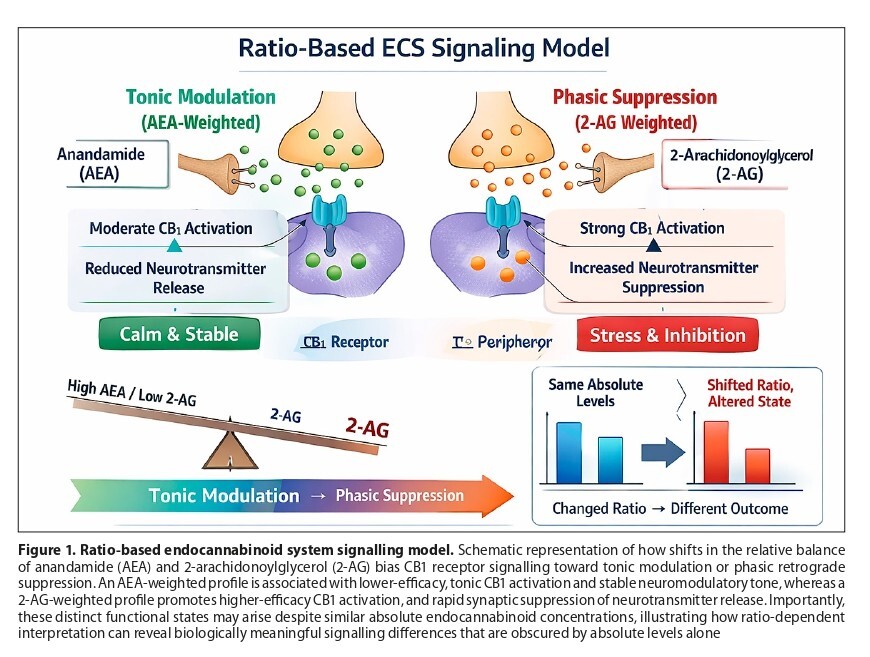
Ratio-based cannabinoid signalling – limitations of absolute endocannabinoid levels in predicting clinical states
1
Research & Publication, AMCANN, LLLP, Murrieta, CA, United States
Corresponding author
David A Dawson
Research & Publication, AMCANN, LLLP, 26359 Jefferson Ave, Suite G, 92562, Murrieta, CA, United States
Research & Publication, AMCANN, LLLP, 26359 Jefferson Ave, Suite G, 92562, Murrieta, CA, United States
J Pre Clin Clin Res. 2026;20(2):71-74
KEYWORDS
endocannabinoid systemanandamideCB1 receptor2-arachidonoylglycerolbiomarker interpretationratio-based signallingFAAHMAGL
TOPICS
ABSTRACT
Introduction and objective:
The endocannabinoid system (ECS) plays a central role in metabolic regulation, immunomodulation, and energy homeostasis. Although absolute circulating endocannabinoid concentrations are commonly used as biomarkers, clinical heterogeneity often persists despite similar absolute levels. The review aims to examine the limitations of absolute-value interpretation and propose a ratio-based framework for understanding cannabinoid signalling dynamics.
Review methods:
A narrative review of peer-reviewed pre-clinical and clinical literature was conducted, focusing on studies examining endocannabinoid signalling, metabolic regulation, insulin sensitivity, and inflammatory tone. Emphasis was placed on studies reporting multiple endocannabinoids concurrently, enabling a comparative or ratio-based interpretation.
Brief description of the state of knowledge:
Current evidence supports the ECS as a coordinated modulatory network rather than a collection of independent signalling molecules. Relative relationships among endocannabinoids appear to better reflect system-level signalling behaviour than single-molecule concentrations alone, although this perspective remains inconsistently applied in clinical interpretation.
Summary:
The review highlights the interpretive limitations of absolute endocannabinoid concentrations and underscores the explanatory value of ratio-based signalling frameworks. The analysis is conservative in scope, synthesizes existing evidence only, and does not propose therapeutic interventions or policy implications.
The endocannabinoid system (ECS) plays a central role in metabolic regulation, immunomodulation, and energy homeostasis. Although absolute circulating endocannabinoid concentrations are commonly used as biomarkers, clinical heterogeneity often persists despite similar absolute levels. The review aims to examine the limitations of absolute-value interpretation and propose a ratio-based framework for understanding cannabinoid signalling dynamics.
Review methods:
A narrative review of peer-reviewed pre-clinical and clinical literature was conducted, focusing on studies examining endocannabinoid signalling, metabolic regulation, insulin sensitivity, and inflammatory tone. Emphasis was placed on studies reporting multiple endocannabinoids concurrently, enabling a comparative or ratio-based interpretation.
Brief description of the state of knowledge:
Current evidence supports the ECS as a coordinated modulatory network rather than a collection of independent signalling molecules. Relative relationships among endocannabinoids appear to better reflect system-level signalling behaviour than single-molecule concentrations alone, although this perspective remains inconsistently applied in clinical interpretation.
Summary:
The review highlights the interpretive limitations of absolute endocannabinoid concentrations and underscores the explanatory value of ratio-based signalling frameworks. The analysis is conservative in scope, synthesizes existing evidence only, and does not propose therapeutic interventions or policy implications.
Dawson DA. Ratio-based cannabinoid signalling – limitations of absolute endocannabinoid levels in predicting clinical states. J Pre-Clin Clin
Res. 2026;20(2):71–74. doi:10.26444/jpccr/221732
REFERENCES (24)
1.
Devane WA, Hanus L, Breuer A, Pertwee RG, Stevenson LA, Griffin G, et al. Isolation and structure of a brain constituent that binds to the cannabinoid receptor. Science. 1992;258(5090):1946–9. doi:10.1126/science.1470919.
2.
Lu HC, Mackie K. An introduction to the endogenous cannabinoid system. Biol Psychiatry. 2016;79(7):516–25. doi:10.1016/j.biopsych.2015.07.028.
3.
Di Marzo V, Piscitelli F. The endocannabinoid system and its modulation by phytocannabinoids. Neurotherapeutics. 2015;12(4):692–8. doi:10.1007/s13311-015-0374-6.
4.
Hill MN, Campolongo P, Yehuda R, Patel S. Integrating endocannabinoid signaling and cannabinoids into the biology and treatment of posttraumatic stress disorder. Neuropsychopharmacology. 2018;43(1):80–102. doi:10.1038/npp.2017.162.
5.
Zou S, Kumar U. Cannabinoid receptors and the endocannabinoid system: signalling and function in the central nervous system. Int J Mol Sci. 2018;19(3):833. doi:10.3390/ijms19030833.
6.
Neumeister A, Seidel J, Ragen BJ, et al. Neurobiological basis of stress-related disorders: role of the endocannabinoid system. Neuropsychopharmacology. 2019;44(1):3–15. doi:10.1038/s41386-018-0214-5.
7.
Cristino L, Bisogno T, Di Marzo V. Cannabinoids and the expanded endocannabinoid system in neurological disorders. Nat Rev Neurol. 2020;16(1):9–29. doi:10.1038/s41582-019-0284-z.
8.
Piomelli D. The molecular logic of endocannabinoid signalling. Nat Rev Neurosci. 2003;4(11):873–84. doi:10.1038/nrn1247.
9.
Patel S, Hill MN. Stress and the endocannabinoid system: a dynamic role in resilience and vulnerability. Nat Rev Neurosci. 2021;22(7):397–414. doi:10.1038/s41583-021-00467-5.
10.
Morena M, Patel S, Bains JS, Hill MN. Neurobiological interactions between stress and the endocannabinoid system. Neuropsychopharmacology. 2019;44(1):19–33. doi:10.1038/s41386-018-0254-x.
11.
Howlett AC. Cannabinoid receptor signaling. Handb Exp Pharmacol. 2005;(168):53–79. doi:10.1007/3-540-26573-2_2.
12.
Sugiura T, Kondo S, Sukagawa A, Nakane S, Shinoda A, Itoh K, et al. Evidence that 2-arachidonoylglycerol but not anandamide is the physiological ligand for the cannabinoid CB1 receptor. J Biol Chem. 1999;274(5):2794–801. doi:10.1074/jbc.274.5.2794.
13.
Kano M, Ohno-Shosaku T, Hashimotodani Y, Uchigashima M, Watanabe M. Endocannabinoid-mediated control of synaptic transmission. Physiol Rev. 2009;89(1):309–380. doi:10.1152/physrev.00019.2008.
14.
Howlett AC, Abood ME. CB1 and CB2 receptor pharmacology. Adv Pharmacol. 2017; 80:169–206. doi:10.1016/bs.apha.2017.03.007.
15.
Pertwee RG. Pharmacology of cannabinoid receptors. Handb Exp Pharmacol. 2005;(168):1–51. doi:10.1007/3-540-26573-2_1.
16.
Gonsiorek W, Lunn C, Fan X, Narula S, Lundell D, Hipkin RW. Endocannabinoid 2-arachidonyl glycerol is a full agonist through human cannabinoid receptor CB2: antagonism by anandamide. Mol Pharmacol. 2000;57(5):1045–50. doi:10.1124/mol.57.5.1045.
17.
McLaughlin RJ, Hill MN. Stress and the endocannabinoid system: neurobiological mechanisms and implications for mental health. Nat Rev Neurosci. 2022;23(3):145–159. doi:10.1038/s41583-021-00525-y.
18.
Russell G, Lightman S. The human stress response. Nat Rev Endocrinol. 2019;15(9):525–534. doi:10.1038/s41574-019-0228-0.
19.
Babic A, Reeves KW. Hormone therapy in menopause: current evidence and clinical guidance. Nat Rev Endocrinol. 2020;16(8):433–445. doi:10.1038/s41574-020-0364-1.
20.
Jonklaas J, Bianco AC, Cappola AR, Celi FS, Fliers E, Heuer H, et al. Guidelines for the treatment of hypothyroidism: prepared by the American Thyroid Association task force on thyroid hormone replacement. Thyroid. 2021;31(3):387–421. doi:10.1089/thy.2020.0720.
21.
Myers B, McKlveen JM, Herman JP. Glucocorticoid actions on synaptic function and behavior. Nat Rev Neurosci. 2019;20(12):765–781. doi:10.1038/s41583-019-0225-1.
22.
Bossuyt PM, Reitsma JB, Bruns DE, Gatsonis CA, Glasziou PP, Irwig L, et al. STARD 2015: an updated list of essential items for reporting diagnostic accuracy studies. BMJ. 2015;351:h5527. doi:10.1136/bmj.h5527.
23.
Rifai N, Watson ID, Miller WG. Clinical laboratory testing: principles, pitfalls, and practicalities. Nat Rev Clin Oncol. 2018;15(6):345–360. doi:10.1038/s41571-018-0004-9.
24.
Ibsen MS, Connor M, Glass M. Cannabinoid CB1 and CB2 receptor signaling and bias. Br J Pharmacol. 2019;176(15):2347–2363. doi:10.1111/bph.14580.
Share
RELATED ARTICLE
| eISSN: | 1898-7516 |
| ISSN: | 1898-2395 |

We process personal data collected when visiting the website. The function of obtaining information about users and their behavior is carried out by voluntarily entered information in forms and saving cookies in end devices. Data, including cookies, are used to provide services, improve the user experience and to analyze the traffic in accordance with the Privacy policy. Data are also collected and processed by Google Analytics tool (more).
You can change cookies settings in your browser. Restricted use of cookies in the browser configuration may affect some functionalities of the website.
You can change cookies settings in your browser. Restricted use of cookies in the browser configuration may affect some functionalities of the website.