Online first
About the Journal
Current issue
Archive
Publication Ethics
Anti-Plagiarism system
Instructions for Authors
Instructions for Reviewers
Editorial Office
Editorial Board
Contact
Reviewers
All Reviewers
2025
2024
2023
2022
2021
2020
2019
2018
2017
2016
General Data Protection Regulation (RODO)

CASE REPORT
Diagnostic and therapeutic challenges in ectopic Cushing’s syndrome without detectable tumour focus – a case report
1
Student's Scientific Society at the Department of Endocrinology and Neuroendocrine Tumors, Department of Pathophysiology and Endocrinology of the Silesian Medical University in Zabrze, Medical University, Katowice, Poland
2
Department of Endocrinology and Neuroendocrine Tumours, Department of Pathophysiology and Endocrinology, Faculty of Medical Sciences, Zabrze, Poland
These authors had equal contribution to this work
Corresponding author
Karolina Patrycja Sas
Student's Scientific Society at the Department of Endocrinology and Neuroendocrine Tumors, Department of Pathophysiology and Endocrinology of the Silesian Medical University in Zabrze, Medical University of Silesia in Katowice, 35 Ceglana St., 40-514 Katowice, Poland
Student's Scientific Society at the Department of Endocrinology and Neuroendocrine Tumors, Department of Pathophysiology and Endocrinology of the Silesian Medical University in Zabrze, Medical University of Silesia in Katowice, 35 Ceglana St., 40-514 Katowice, Poland
J Pre Clin Clin Res. 2026;20(1):16-20
KEYWORDS
TOPICS
ABSTRACT
Ectopic adrenocorticotropin (ACTH) secretion is a rare cause of Cushing’s syndrome, often posing a diagnostic challenge,
particularly when the source of excessive ACTH secretion cannot be localized. The case is presented of a 70-year-old woman
with Cushing’s syndrome caused by ectopic ACTH secretion from an elusive location. Despite extensive imaging (CT, MRI,
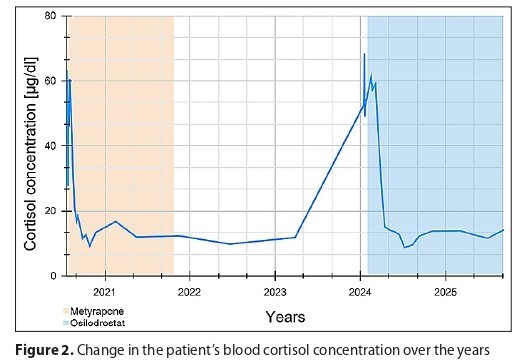
PET/CT with 68Ga-DOTATATE), no tumour site could be identified. Metyrapone led to normalization of cortisol and ACTH
levels and a two-year remission. After a recurrence of hypercortisolaemia, osilodrostat therapy was initiated, achieving
renewed hormonal and clinical stabilization. This case highlights the importance of pharmacotherapy with steroidogenesis
inhibitors as an effective alternative to surgery in patients with an unlocalized source of ectopic ACTH secretion, and the
need for long-term endocrine follow-up.
Sas KP, Tokarczyk K, Zieliński D, Strzelczyk J. Diagnostic and therapeutic challenges in ectopic Cushing’s syndrome without detectable tumour
focus – a case report. J Pre-Clin Clin Res. 2026;20(1):16–20. doi:10.26444/jpccr/217869
REFERENCES (22)
1.
Cai Y, Ren L, Tan S, et al. Mechanism, diagnosis, and treatment of cyclic Cushing’s syndrome: A review. Biomed Pharmacother. 2022;153:113301.
2.
Guignat L, Bertherat J. Medical Treatment of Cushing’s Syndrome.Endocrinol Metab (Seoul). 2025;40(1):26–38.
3.
Ewert J, Seidl M, Hommen JA, Schott M, Gattermann N. Ectopic CRH/ACTH-Co-Secreting Neuroendocrine Tumors Leading to Cushing’s Disease – A Case Presentation and Literature Review.Neuroendocrinology. Published online: February 14, 2025:1–29.
4.
Hakami OA, Ahmed S, Karavitaki N. Epidemiology and mortality of Cushing’s syndrome. Best Pract Res Clin Endocrinol Metab. 2021;35(1):101521.
5.
Abouibrahim M, Rahman M, Zafar M, et al. Unusual Presentation of Case of a Lung Carcinoid Tumor With Ectopic Adrenocorticotropic Secretion (EAS) Associated With Acute Weight Gain and Peripheral Edema.Cureus. 2024;16(7):e63619.
6.
Juszczak A, Morris D, Grossman A. Cushing’s Syndrome. In: Endotext [Internet].MDText.com, Inc.; 2024.
7.
Martino MCD, Canu L, Bonaventura I, Vitiello C, Sparano C, Cozzolino A. Hypertension and Cushing’s syndrome: hunt for the red flag. J Endocrinol Invest. 2025;48(8):1909–1918.
8.
Cai Y, Zhao X, Ren L, et al. Clinical features and risk factors for postoperative recurrence in patients with Cushing’s syndrome of different etiologies. Sci Rep. 2024;14(1):4666.
9.
Cieszyński Ł, Berendt-Obołończyk M, Szulc M, Sworczak K. Cushing’s syndrome due to ectopic ACTH secretion. Endocrinol Pol. 2016;67(4):458–471.
10.
Pivonello R, Ferrigno R, De Martino MC, et al. Medical Treatment of Cushing’s Disease: An Overview of the Current and Recent Clinical Trials. Front Endocrinol (Lausanne). 2020;11:648.
11.
Kargun S, Aydemir M, Yilmaz N, Gürer İE, Sari R, Altunbas H. An aggressive Cushing’s syndrome originating from a rare thymic neuroendocrine tumor, controlled successfully with fluconazole and octreotide therapy before surgery. J Cancer Res Ther. Published online August 16, 2024. doi:10.4103/jcrt.jcrt_644_22.
12.
Alba EL, Japp EA, Fernandez-Ranvier G, et al. The Mount Sinai Clinical Pathway for the Diagnosis and Management of Hypercortisolism due to Ectopic ACTH Syndrome. J Endocr Soc. 2022;6(7):bvac073.
13.
Smushkin G, Phillips R, Chausse G. The Elusive Neuroendocrine Tumor: Finding the Ectopic ACTH Source 16 Years After the Diagnosis of Cushing Syndrome. JCEM Case Rep. 2023;1(1):luac035.
14.
Lurquin F, Constantinescu SM, Furnica RM, et al. Ectopic sphenoidal ACTH-secreting adenoma revealed by C Methionine PET scan: case report. BMC Endocr Disord. 2023;23(1):43.
15.
Wong TW. Long-term Treatment With Metyrapone in a Man With Ectopic Cushing Syndrome. JCEM Case Rep. 2023;1(1):luac008.
16.
Iwayama H, Hirase S, Nomura Y, et al. Spontaneous adrenocorticotropic hormone (ACTH) normalization due to tumor regression induced by metyrapone in a patient with ectopic ACTH syndrome: case report and literature review. BMC Endocr Disord. 2018;18(1):19.
17.
Sawabe F, Hayafusa R, Kosugi R, Ariyasu H. A Case of an Ectopic ACTH-Producing Tumor With Adrenal Shrinkage During Osilodrostat Administration. JCEM Case Rep. 2024;2(2):luae008.
18.
Dormoy A, Haissaguerre M, Vitellius G, et al. Efficacy and Safety of Osilodrostat in Paraneoplastic Cushing Syndrome: A Real-World Multicenter Study in France. J Clin Endocrinol Metab. 2023;108(6):1475–1487.
19.
Chacko R, Abdel-Razeq NH, Abu Rous F, Loutfi R. Abiraterone acetate for treatment of ectopic Cushing syndrome caused by ACTH-producing neuroendocrine tumor: a case report. J Gastrointest Oncol. 2022;13(5):2626–2632.
20.
Sobolewska J, Działach Ł, Respondek W, Wojciechowska-Luźniak A, Witek P. Ectopic ACTH syndrome in the course of ACTH-secreting pancreatic neuroendocrine tumor in a patient with a pituitary lesion – diagnostic challenges and individual approach. Endocrinol Pol. 2024;75(1):113–114.
21.
Valizadeh M, Abiri B, Hosseinpanah F, Grossman A. Bilateral inferior petrosal sinus sampling in the differential diagnosis of ACTH-dependent Cushing’s syndrome: A reappraisal. Journal of internal medicine. 2024;296(1):2–23.
22.
Wang H Ba Y, Xing Q, Cai RC. Differential diagnostic value of bilateral inferior Petrosal sinus sampling (BIPSS) in ACTH-dependent Cushing syndrome: a systematic review and Meta-analysis. BM. 2020; 20(1):143.
| eISSN: | 1898-7516 |
| ISSN: | 1898-2395 |

We process personal data collected when visiting the website. The function of obtaining information about users and their behavior is carried out by voluntarily entered information in forms and saving cookies in end devices. Data, including cookies, are used to provide services, improve the user experience and to analyze the traffic in accordance with the Privacy policy. Data are also collected and processed by Google Analytics tool (more).
You can change cookies settings in your browser. Restricted use of cookies in the browser configuration may affect some functionalities of the website.
You can change cookies settings in your browser. Restricted use of cookies in the browser configuration may affect some functionalities of the website.