Online first
About the Journal
Current issue
Archive
Publication Ethics
Anti-Plagiarism system
Instructions for Authors
Instructions for Reviewers
Editorial Office
Editorial Board
Contact
Reviewers
All Reviewers
2025
2024
2023
2022
2021
2020
2019
2018
2017
2016
General Data Protection Regulation (RODO)

REVIEW PAPER
Osteopathic treatment of non-synostotic plagiocephaly in infants – a systematic review
1
Institute of Health Sciences, Department of Rehabilitation and Biological Regeneration, Pomeranian University, Słupsk, Poland
2
Podmiot Leczniczy Samorządu Województwa Pomorskiego, Sanatorium Uzdrowiskowym Green Garden
Corresponding author
Jakub Pawłowski
Department of Rehabilitation and Biological Regeneration, Institute of Health Sciences, Pomeranian University, Arciszewskiego 22A, 76–200, Słupsk, Poland
Department of Rehabilitation and Biological Regeneration, Institute of Health Sciences, Pomeranian University, Arciszewskiego 22A, 76–200, Słupsk, Poland
J Pre Clin Clin Res. 2026;20(2):95-99
KEYWORDS
TOPICS
ABSTRACT
Introduction and objective:
Deformational (non-synostotic positional) plagiocephaly is a frequent craniofacial asymmetry in infants caused by prolonged external pressure on the neonatal skull. It may lead to motor delays, postural asymmetries and neurodevelopmental issues. Osteopathic manipulative treatment (OMT) is used as a gentle, non-invasive approach to improve cranial symmetry and support development. The aim of this systematic review is to evaluate the effectiveness and safety of OMT in infants under 12 months with non-synostotic positional plagiocephaly.
Review methods:
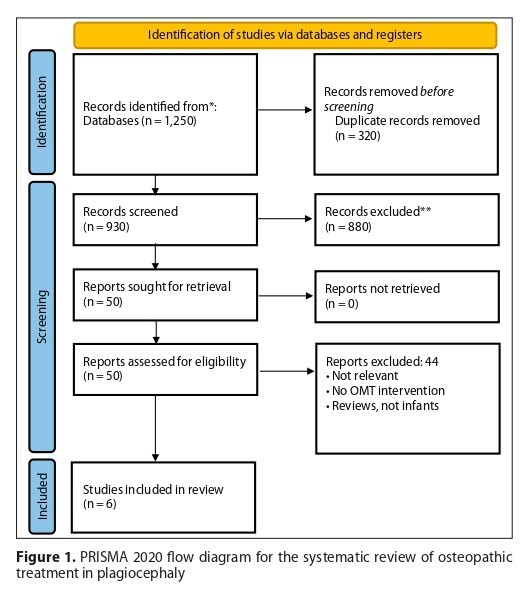
Six clinical studies (two RCTs, one large cohort, one outcome research, one chart review and one pilot study) assessing OMT with validated anthropometric measures (ODDI, CVAI, CVA) were included. Methodological quality was evaluated using the Downs and Black checklist.
Brief description of the state of knowledge:
OMT was typically delivered in 3–6 sessions. Most studies showed significant or clinically relevant reductions in cranial asymmetry. Benefits were observed in both therapeutic and preventive settings. High parental satisfaction and excellent safety (no adverse events) were consistently reported.
Summary:
Available evidence indicates that OMT is a safe and potentially effective complementary intervention for non-synostotic positional plagiocephaly in infants. Early application may improve cranial symmetry and support neurodevelopment. However, due to heterogeneity, small samples and limited long-term data, high-quality multicentre RCTs are required to confirm these findings.
Deformational (non-synostotic positional) plagiocephaly is a frequent craniofacial asymmetry in infants caused by prolonged external pressure on the neonatal skull. It may lead to motor delays, postural asymmetries and neurodevelopmental issues. Osteopathic manipulative treatment (OMT) is used as a gentle, non-invasive approach to improve cranial symmetry and support development. The aim of this systematic review is to evaluate the effectiveness and safety of OMT in infants under 12 months with non-synostotic positional plagiocephaly.
Review methods:
Six clinical studies (two RCTs, one large cohort, one outcome research, one chart review and one pilot study) assessing OMT with validated anthropometric measures (ODDI, CVAI, CVA) were included. Methodological quality was evaluated using the Downs and Black checklist.
Brief description of the state of knowledge:
OMT was typically delivered in 3–6 sessions. Most studies showed significant or clinically relevant reductions in cranial asymmetry. Benefits were observed in both therapeutic and preventive settings. High parental satisfaction and excellent safety (no adverse events) were consistently reported.
Summary:
Available evidence indicates that OMT is a safe and potentially effective complementary intervention for non-synostotic positional plagiocephaly in infants. Early application may improve cranial symmetry and support neurodevelopment. However, due to heterogeneity, small samples and limited long-term data, high-quality multicentre RCTs are required to confirm these findings.
Pawłowski J, Sztuka W. Osteopathic treatment of non-synostotic plagiocephaly in infants: – a systematic review. J Pre-Clin Clin Res. 2026;20(2):95–99. doi:10.26444/jpccr/222266
REFERENCES (12)
1.
Filisetti M, Cattarelli D, Bonomi S. Positional plagiocephaly from structure to function: Clinical experience of the service of pediatric osteopathy in Italy. Early Hum Dev. 2020;146:105026.
2.
Panza R, Piarulli F, Rizzo V, et al. Positional plagiocephaly: results of the osteopathic treatment of 424 infants. An observational retrospective cohort study. Ital J Pediatr. 2024;50:166.
3.
Bagagiolo D, Priolo CG, Favre EM, et al. A Randomized Controlled Trial of Osteopathic Manipulative Therapy to Reduce Cranial Asymmetries in Young Infants with Nonsynostotic Plagiocephaly. Am J Perinatol. 2022;39(Suppl 1):S52–S62.
4.
Lessard S, Gagnon I, Trottier N. Exploring the impact of osteopathic treatment on cranial asymmetries associated with nonsynostotic plagiocephaly in infants. Complement Ther Clin Pract. 2011;17(4):193–8.
5.
King HH, Mai J, Morelli Haskell MA, Wolf K, Sweeney M. Effects of osteopathic manipulative treatment on children with plagiocephaly in the context of current pediatric practice: a retrospective chart review study. J Osteopath Med. 2024;124(4):171–7.
6.
Genelot C, Macioce V, Huguet H, et al. Early osteopathic manipulative treatment to prevent cranial positional deformities: A randomized controlled trial. Arch Pediatr. 2025;32(3):203–10.
7.
McElwain SK, Schmidt D. Predictability of cranial base strains as related to birth presentation: a review of literature. J Osteopath Med. 2025. doi:10.1515/jom-2025–0124.
8.
Ellwood J, Draper-Rodi J, Carnes D. The effectiveness and safety of conservative interventions for positional plagiocephaly and congenital muscular torticollis: a synthesis of systematic reviews and guidance. Chiropr Man Therap. 2020;28:31.
9.
Cabrera-Martos I, Ortigosa-Gómez SJ, López-López L, et al. Physical Therapist Interventions for Infants With Nonsynostotic Positional Head Deformities: A Systematic Review. Phys Ther. 2021;101(8):pzab106.
10.
Page MJ, McKenzie JE, Bossuyt PM, et al. The PRISMA 2020 statement: an updated guideline for reporting systematic reviews. BMJ. 2021;372:n71.
11.
Downs SH, Black N. The feasibility of creating a checklist for the assessment of the methodological quality both of randomised and non-randomised studies of health care interventions. J Epidemiol Community Health. 1998;52(6):377–84.
12.
Gasperini M, Vanacore N, Massimi L, et al. Effects of osteopathic approach in infants with deformational plagiocephaly: an outcome research study. Minerva Pediatr (Torino). 2021;75(2):200–8.
| eISSN: | 1898-7516 |
| ISSN: | 1898-2395 |

We process personal data collected when visiting the website. The function of obtaining information about users and their behavior is carried out by voluntarily entered information in forms and saving cookies in end devices. Data, including cookies, are used to provide services, improve the user experience and to analyze the traffic in accordance with the Privacy policy. Data are also collected and processed by Google Analytics tool (more).
You can change cookies settings in your browser. Restricted use of cookies in the browser configuration may affect some functionalities of the website.
You can change cookies settings in your browser. Restricted use of cookies in the browser configuration may affect some functionalities of the website.